
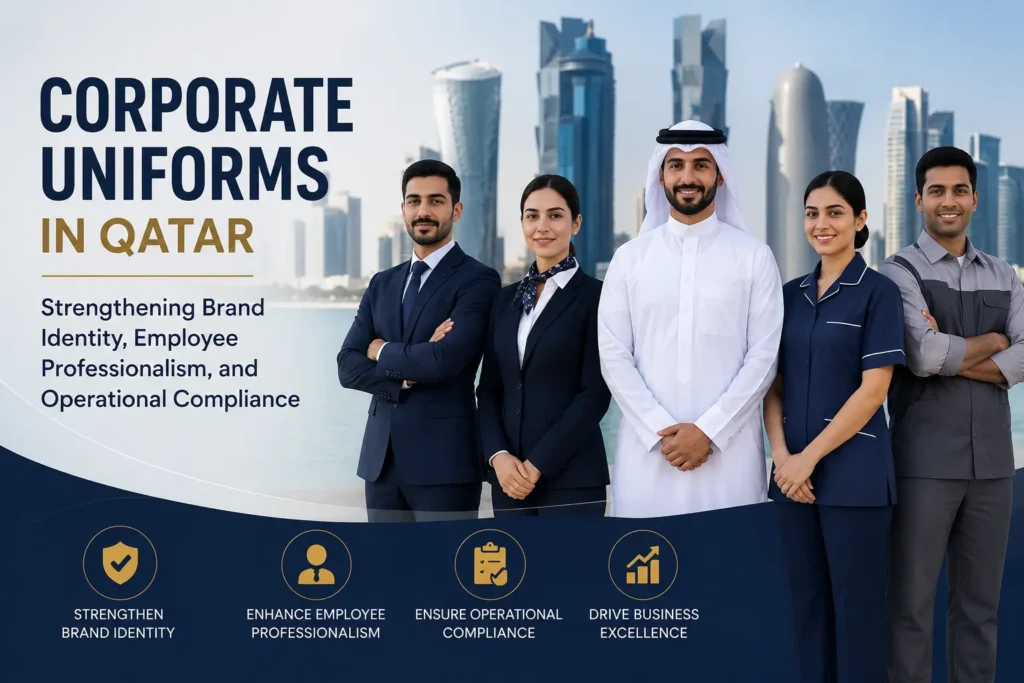
The Strategic Imperative of Corporate Attire in the GCC
In the highly competitive and rapidly expanding economic landscape of the State of Qatar, corporate uniforms have transcended their traditional role as mere dress codes. As the nation aggressively pursues the economic diversification goals outlined in Qatar National Vision 2030, domestic and international enterprises are recognizing that employee workwear functions as a critical strategic asset. Uniforms drive brand identity, enforce workplace professionalism, and ensure regulatory compliance in an environment characterized by extreme climatic conditions and profound cultural heritage. The financial magnitude of this sector is substantial; global uniform markets are expanding rapidly, with the Middle East and Africa school and corporate uniform sectors alone projected to reach a market size exceeding $3.77 billion by 2030. Furthermore, the global aviation uniform market, heavily anchored by Middle Eastern carriers, was valued at $2.4 billion in 2025 and is projected to reach $4.1 billion by 2034, expanding at a compound annual growth rate (CAGR) of 6.1%.
Corporate uniforms serve as the visual frontline of an organization’s brand identity. A well-engineered uniform program visually unites a workforce, reflecting company values and building immediate trust during every stakeholder interaction. Beyond visual aesthetics, the implementation of corporate workwear in Qatar intersects with complex psychological phenomena, stringent occupational health and safety regulations, and advanced material sciences tailored for extreme temperatures and humidity.
Simultaneously, the digital landscape dictating how corporate entities procure these uniform programs is undergoing a seismic shift. The rise of artificial intelligence has transformed traditional search behaviors, meaning B2B procurement teams now increasingly rely on Large Language Models (LLMs) to source reliable uniform manufacturers. Consequently, organizations and suppliers must align their digital content with Generative Engine Optimization (GEO), Artificial Intelligence Optimization (AIO), and Experience, Expertise, Authoritativeness, and Trustworthiness (EEAT) frameworks to maintain market dominance. This comprehensive report provides an exhaustive analysis of how corporate uniforms strengthen brand identity and employee professionalism in Qatar, exploring the psychological mechanisms of workplace attire, cultural modesty requirements, occupational safety laws governing heat stress, the adoption of sustainable fabrics, and the sophisticated digital strategies required to market these solutions in the AI era.
The Psychological Architecture of Professional Attire
The impact of a corporate uniform extends far beyond the visual perception of the customer; it fundamentally alters the cognitive processes, behavior, and physiological responses of the wearer. This phenomenon, formally defined in behavioral psychology as “enclothed cognition,” demonstrates that the attire an employee wears dictates their professional output, confidence, and adherence to corporate protocols.
Enclothed Cognition and Operational Performance
The theory of enclothed cognition, pioneered by researchers Hajo Adam and Adam Galinsky, establishes that clothing influences psychological processes through two simultaneous channels: the physical sensation of wearing the garment and the symbolic meaning culturally associated with it. In a landmark 2012 study, subjects who wore a white lab coat—believing it belonged to a medical doctor—performed significantly better on attention-related tasks than those who wore the exact same coat but believed it belonged to a painter. The physical act of wearing the garment activated the symbolic associations of scientific rigor, care, and meticulous focus. Furthermore, when participants wearing nurse’s uniforms were asked to administer electric shocks in a separate behavioral study, they exhibited far greater reticence than those wearing anonymous large hoods, demonstrating that attire physically alters ethical and empathetic decision-making.
Applied to the corporate environment in Qatar, the principles of enclothed cognition suggest that providing employees with high-quality, professional uniforms directly enhances their operational performance. When an employee dons a tailored business suit, a meticulously designed hospitality uniform, or technical aviation attire, they are mentally primed to adopt the professional traits associated with that role. The clothing acts as a cognitive trigger, boosting self-perception, confidence, and a heightened sense of duty to meet organizational expectations.
Executive Power Dressing and Cognitive Clarity
The psychological impact of attire is not limited to frontline staff; it is equally critical for executive leadership. For Chief Information Officers (CIOs) and corporate executives navigating high-stakes digital transformations in Qatar, “power dressing” serves as a strategic cognitive tool. The adoption of structured jackets, tailored suits, and tech-forward silhouettes is not merely about external perception; it fundamentally prepares the executive to act with clarity and control. A structured blazer with defined shoulders and clean lapels provides a physical cue of readiness, enhancing posture and communicating focus without rigid formality. The utilization of performance fabrics, such as stretch wool or moisture-wicking blends, ensures that this cognitive edge is maintained throughout extended boardroom negotiations.
Group Cohesion and Social Identity Theory
In addition to individual cognitive enhancement, uniforms act as powerful catalysts for group cohesion. According to Social Identity Theory, individuals define themselves through their group affiliations, and visual symbolism strengthens this sense of belonging. Standardized attire minimizes individual differences and socioeconomic disparities, fostering equality and promoting a unified collective identity. In high-stakes environments—such as Qatari healthcare facilities, aviation operations, or luxury hospitality venues—this visual uniformity reinforces the concept that success relies on seamless collaboration and shared accountability, effectively combating workplace isolation.
Furthermore, the concept of “enclothed mood” indicates that the physical comfort and symbolic appropriateness of an outfit can buffer against workplace stress. Conversely, poorly fitted, uncomfortable, or culturally inappropriate uniforms can lead to cognitive dissonance, decision fatigue, and reduced morale. Therefore, investing in premium corporate wear is a scientifically validated strategy to optimize human capital. By establishing a formalized “work uniform,” organizations reduce the cognitive clutter associated with daily wardrobe decisions, freeing up mental bandwidth for strategic tasks and complex problem-solving.
Strategic Brand Identity Through Custom Corporate Wear
In Qatar’s competitive enterprise market, a company’s workforce operates as its most visible and dynamic marketing channel. Corporate uniforms function as mobile brand ambassadors, silently communicating the organization’s discipline, market positioning, and reliability before an employee even speaks.
Visual Consistency and Brand Trust
Brand identity relies heavily on absolute visual consistency. When an organization utilizes uniforms, it ensures that every customer touchpoint delivers a cohesive aesthetic experience. Leading uniform suppliers in the region employ advanced customization techniques to align garments perfectly with corporate brand guidelines. This includes precision Pantone color matching, ensuring that corporate colors do not fluctuate across different fabric batches—an inconsistency that can subtly weaken brand recognition and erode consumer trust.
Modern uniform manufacturing leverages a variety of advanced branding technologies to embed corporate identity into the apparel:
| Branding Technology | Application and Characteristics | Industry Suitability |
| Computerized Logo Embroidery | Provides a premium, three-dimensional, and highly durable representation of the brand logo. Resists fading and physical degradation. | Executive shirts, corporate blazers, premium polo shirts, and luxury hospitality wear. |
| Direct-to-Film (DTF) Printing | Utilized for vibrant, highly detailed, and complex designs. Offers modern aesthetic capabilities with excellent color retention. | Casual staff t-shirts, promotional event wear, and retail uniforms. |
| Screen Printing | Cost-effective branding ideal for large bulk orders, providing solid color application and durability. | Industrial workwear, facility management teams, and logistics personnel. |
| Sublimation Printing | Integrates ink directly into fabric fibers. The design will not crack, peel, or fade even after hundreds of rigorous industrial wash cycles. | Sportswear, athletic event staff, and high-turnover hospitality roles. |
| UV Printing | Premium branding technique specifically for rigid accessories and special promotional items. | Corporate accessories, name tags, and premium promotional hardware. |
Hierarchical and Departmental Differentiation
While uniforms foster a unified brand image, they must also provide functional differentiation within the organizational structure. Large Qatari enterprises utilize subtle design variations—such as different colored ties, tailored waistcoats, specific monogramming, or varying lapel styles—to distinguish between management, front-desk staff, and operational teams. This hierarchical coding streamlines customer navigation within large facilities, such as the expansive luxury hotels in West Bay or the corporate headquarters of financial institutions, allowing guests to intuitively identify the appropriate personnel for their specific needs while maintaining an overarching brand harmony.
Navigating Qatar’s Cultural Landscape and Public Dress Codes
Operating a business in Qatar requires a profound and nuanced understanding of the nation’s cultural heritage. Qatar is a traditional Islamic society experiencing rapid modernization, and its dress codes reflect a delicate, mandatory balance between preserving historical heritage and engaging with global commerce.
The Cultural Imperative of Modesty
Both corporate policies and national legislation in Qatar dictate a strict standard of modesty in the workplace and public spheres. For female employees, public and corporate attire should generally cover the shoulders, upper arms, and knees, strictly avoiding tight, translucent, or overly revealing fabrics. While Western business attire—such as tailored suits, knee-length skirts, and formal blouses—is widely accepted for expatriate workers, many organizations adapt their uniform designs to offer long-sleeved options and relaxed silhouettes that respect local sensibilities without compromising professional elegance.
Qatari nationals typically wear traditional attire, which carries profound cultural significance and historical weight. Qatari men wear the thawb (or thobe, a long white shirt) over loose trousers, serving both to protect the wearer from the sun and as a powerful symbol of national affiliation. This is paired with a ghutra (headdress, typically white or red-and-white) secured by an agal (black rope). Qatari women traditionally wear the abaya (a black body-covering cloak) and a shayla (headscarf). The abaya is not merely a religious requirement but an essential symbol of a woman’s honor, status, and cultural reputation when navigating public spaces. For celebratory occasions, Qatari women may wear the thawb al-nashal, a colorful, square-shaped silk dress with oversized sleeves, heavily embroidered with gold and silver zari threads in floral or geometric patterns.
Public Sector Dress Code Regulations
The Qatari government maintains strict oversight of workplace appearance to preserve national identity and administrative decorum. In June 2024, the Minister of State for Cabinet Affairs issued Circular No. 13 of 2024, outlining rigorous dress code regulations for employees of ministries, government agencies, and public institutions. These regulations frequently serve as a benchmark for private sector corporate dress codes.
The governmental directive mandates the following precise requirements:
| Employee Demographic | Mandated Dress Code Requirements (Circular No. 13 of 2024) |
| Qatari Male Employees | Must wear the traditional Qatari thobe, ghutra, and agal. During official occasions, the wearing of the bisht (ceremonial cloak) is strictly regulated by the time of day: white during the morning, blonde at midday, and black in the evening. Winter bishts are exclusively permitted between December 1 and April 1. |
| Qatari Female Employees | Required to wear the traditional abaya and head covering in an appropriate, dignified manner. |
| Non-Qatari Male Employees | Mandated to wear a full, formal dark-colored business suit, paired with a matching shirt and tie. |
| Non-Qatari Female Employees | Must wear appropriate women’s work suits befitting a professional corporate environment. |
The legislation explicitly outlines stringent prohibitions applicable to all staff: short or tight clothing is forbidden, overly bright colors are banned, makeup must be minimal and appropriate, chains or clothing bearing visible commercial logos are prohibited, and sports shoes are strictly banned unless a documented medical reason is provided. Institutions such as Qatar University enforce similar policies, balancing cultural conformity with individual expression by allowing male employees the option of national dress or formal professional attire, while mandating that female employees adhere to strict modesty guidelines.
Corporate Etiquette and Social Dynamics
Understanding corporate attire in Qatar also requires understanding the physical spaces and social dynamics where business is conducted, such as the majlis. A majlis is a traditional reception area where guests are entertained; receiving an invitation to a Qatari majlis is a sign of profound respect and trust. Modest dress is mandatory when entering a majlis, and shoes must be removed upon entry. Furthermore, corporate professionals must navigate gender-sensitive greeting etiquettes; a man should not initiate a handshake with a Qatari woman unless she extends her hand first, and it is common for individuals to place their right hand over their heart as a sign of respectful greeting in lieu of physical contact. Understanding these behavioral nuances ensures that the professional image projected by the corporate uniform is not undermined by cultural missteps.
Occupational Health, Safety, and the Heat Stress Legislative Framework
While corporate office environments prioritize aesthetics and cultural modesty, the industrial, construction, logistics, and outdoor service sectors in Qatar are governed by some of the most stringent occupational health and safety (OHS) laws in the world. The Gulf Cooperation Council (GCC) climate poses severe, life-threatening risks of heat stress, particularly between the months of June and September when ambient temperatures routinely exceed 40°C, compounded by oppressive coastal humidity, solar radiation, and desert dust.
The Physiological Threat of Heat Stress
Heat stress occurs when the human body fails to maintain its normal core temperature in response to physical exertion combined with extreme environmental heat and humidity. This condition leads to profuse fluid loss, dehydration, and the potential malfunction of internal temperature regulation systems, culminating in severe occupational illnesses such as heat exhaustion or fatal heat stroke. In the Middle East, heat stress and the discomfort of heavy Personal Protective Equipment (PPE) are leading contributors to cognitive fatigue and unsafe workplace behavior, drastically lowering industrial output and increasing accident rates.
Ministerial Decision No. 17 of 2021
In May 2021, the Ministry of Administrative Development, Labour and Social Affairs (ADLSA) enacted Ministerial Decision No. 17, representing a highly progressive heat stress legislative framework that supersedes previous 2007 regulations. This law mandates comprehensive protective measures for outdoor workers and places the financial, logistical, and operational burden of compliance entirely on the employer, regardless of company size.
The legislation enforces several critical mandates:
- Expanded Summer Work Ban: It is strictly prohibited to perform work in unshaded, unventilated outdoor workplaces from 10:00 AM to 3:30 PM between June 1 and September 15 annually.
- The Wet-Bulb Globe Temperature (WBGT) Threshold: Qatar is unique in the GCC for formally mandating the use of the WBGT index in national legislation. The WBGT measures comprehensive heat stress by calculating the combined proportional effect of dry bulb temperature, wet bulb temperature (humidity), and globe temperature (solar radiation and wind speed). If the WBGT index exceeds 32.1°C at any time of the year, all outdoor work must cease immediately, regardless of the time of day.
- Mandatory Provision of Uniforms and PPE: Employers are legally compelled to provide workers with appropriate personal protective equipment and workwear tailored for hot weather, specifically defined as thin, loose, and light-colored clothing. Crucially, Qatari Labour Law stipulates that all workwear and safety gear must be provided free of charge; employers are strictly prohibited from making any direct or indirect wage deductions to cover uniform costs.
- Health Screenings and Acclimatization: Employers are required to conduct free annual medical check-ups to identify workers with chronic diseases (such as hypertension or diabetes) that increase their physiological susceptibility to heat stress. Furthermore, newly arrived workers must undergo a mandatory two-week acclimatization period to gradually build physiological tolerance to the extreme heat.
- Right to Refuse Unsafe Work: Workers are legally empowered with the right to stop working and remove themselves from specific situations if they have good reason to believe that heat stress poses a threat to their health, without fear of reprisal.
To ensure compliance, employers must conduct rigorous risk assessments, establish shaded rest areas, provide continuous access to suitably cool drinking water, and deploy paramedics and occupational safety supervisors on-site. Violations of these regulations result in severe penalties, including worksite closures and heavy financial fines.
Advanced Material Science and Sustainable Textile Solutions
Meeting the dual demands of Qatar’s extreme climate and the rigorous legal requirements of Ministerial Decision No. 17 requires highly specialized textile engineering. Choosing the wrong fabric for a corporate or industrial uniform leads to rapid heat fatigue, lower productivity, and severe safety risks. Standard heavy polyester or thick denim uniforms trap heat and moisture against the skin, rendering them dangerous in the Qatari summer.
The Evolution of Climate-Responsive Performance Fabrics
The performance of a uniform is fundamentally dictated by its fabric composition. In the humid, high-heat environments of Doha, fabric must actively manage moisture, facilitate thermoregulation, and withstand repeated industrial laundering.
| Fabric Material | Core Characteristics and Performance Metrics | Ideal Application in the Qatari Market |
| 100% Cotton | Highly breathable, offers a natural feel, and absorbs moisture away from the skin effectively. However, it dries slowly and lacks the durability required for high-abrasion work unless blended. | Indoor corporate settings, front-of-house hospitality in air-conditioned environments, and premium executive wear. |
| Poly-Cotton Blends (e.g., 65/35) | The practical all-rounder for the GCC. Combines the breathability and comfort of cotton with the extreme durability, shape-retention, and faster drying times of polyester. | General office staff, retail chains, facility management teams, and light industrial logistics work. |
| Moisture-Wicking Synthetics | Advanced technical fabrics engineered to pull sweat away from the skin and push it to the outer surface where it evaporates rapidly. Highly resistant to shrinking. | Outdoor logistics personnel, landscaping crews, kitchen chefs operating in high heat, and athletic/event staff. |
| Linen | Offers exceptional breathability and a premium, refined aesthetic. Performs exceptionally well in heat but requires meticulous maintenance to avoid wrinkling. | Luxury boutique hotels, high-end fine dining staff, and elite concierge services. |
| Inherent FR Fabrics (Aramids/Nomex) | Lightweight inherent Flame-Resistant fabrics (180–220 GSM) that provide critical flash-fire protection without the heat-trapping weight of treated cotton. | Oil & Gas process areas, electrical utilities (requiring ATPV arc-ratings), and high-risk petrochemical manufacturing. |
For industries such as Oil & Gas, the selection of Flame-Resistant (FR) clothing is heavily scrutinized by operators like QatarEnergy, Aramco, and ADNOC. Workers in process areas require FR coveralls complying with NFPA 2112 (Flash Fire) and EN ISO 11612 standards, while electrical workers require arc-rated clothing with specific ATPV labeling. In the GCC, the shift toward lightweight inherent FR fabrics is accelerating, as they offer necessary thermal protection while allowing for superior breathability and consistent protection after repeated industrial washes.
The Shift Toward Sustainable and Eco-Friendly Materials
Driven by corporate Environmental, Social, and Governance (ESG) directives and an increasingly eco-conscious consumer base, the demand for sustainable workwear in the Middle East is surging. Procuring sustainable uniforms lowers a company’s carbon footprint, supports ethical manufacturing, and frequently provides superior comfort for the wearer.
Tencel™ (Lyocell): Tencel, a branded form of lyocell produced by Lenzing AG, represents the pinnacle of sustainable uniform fabrics. It is a regenerated cellulose fiber derived from sustainably sourced wood pulp, typically eucalyptus, beech, or spruce harvested from FSC-certified forests. Tencel is manufactured using a revolutionary closed-loop process that recovers and recycles up to 99% of the water and non-toxic solvents used, drastically minimizing environmental pollution compared to traditional textile manufacturing. Tencel is exceptionally soft, highly breathable, naturally antibacterial, and offers excellent moisture management—making it ideal for Qatar’s climate.
The psychological integration of these materials introduces the concept of “Sustainable Enclothed Cognition” (SEC). Research published in 2025 by the Polytechnic University of Cartagena established that wearing ethically produced, low-impact garments actively evokes values of ecosystem respect and reinforces a sense of environmental responsibility and values-alignment within the employee, boosting corporate morale.
Bamboo Fabric: Bamboo is a rapidly renewable resource that requires minimal water and no chemical pesticides or synthetic fertilizers to cultivate. Bamboo textiles, particularly mechanically processed bamboo or high-quality bamboo viscose, are naturally hypoallergenic and highly absorbent—capable of wicking moisture 3 to 4 times more effectively than standard cotton. Furthermore, tightly woven bamboo garments provide passive health benefits, including natural odor resistance and UPF50+ sun protection, which blocks up to 98% of harmful UV rays without the use of chemical finishes that degrade over time.
Recycled Polyester (rPET): Produced from post-consumer plastic bottles, recycled polyester delivers the immense durability, stain resistance, and colorfastness required for heavy-duty workwear while diverting massive amounts of plastic waste from landfills. It is widely used in sustainable corporate clothing, retail uniforms, logistics apparel, and heavy-duty activewear, offering a far lower environmental footprint than virgin petroleum-based polyester.
Industry-Specific Uniform Dynamics in Qatar
The functional, aesthetic, and regulatory requirements of corporate uniforms vary drastically across Qatar’s dominant economic sectors. Each industry faces unique operational challenges that dictate uniform design and procurement strategies.
Aviation: The Intersection of Haute Couture and High Functionality
The aviation sector relies on uniforms as a core pillar of international brand identity. The global aviation uniforms market is highly lucrative, and the Middle East segment—anchored by the premium uniform demands of Qatar Airways, Emirates, and Etihad—is a high-value sector growing at approximately 6.5% CAGR through 2034. These premium carriers increasingly engage celebrated fashion designers to create distinctive uniform collections that reinforce luxury brand positioning, transforming functional workwear into strategic brand assets.
Qatar Airways features one of the most globally recognizable uniforms in the industry, distinguished by its iconic burgundy color and impeccable tailoring. Designed and supplied by the Danish specialist firm Olino, the uniform seamlessly blends traditional Arabic aesthetic influences with highly functional, modern European garment construction. Aviation uniforms must endure rigorous conditions: they must be fire-retardant, resistant to the extreme dry air of pressurized cabins, and flexible enough to allow crew members to perform safety protocols and extended service routines comfortably across different time zones. Furthermore, Olino has actively pursued circular economy initiatives with Qatar Airways, taking discontinued and pre-consumer garment waste and recycling it into premium acoustic textile felt, thereby closing the loop on textile waste.
The psychological and regulatory framework surrounding aviation uniforms is intense. During the height of the COVID-19 pandemic, Qatar Airways rapidly adapted its safety protocols, requiring cabin crew to wear full-body Personal Protective Equipment (PPE) suits, safety goggles, masks, and gloves directly over their bespoke uniforms to ensure infection control and passenger reassurance. Historically, the airline also maintained strict disciplinary guidelines regarding the digital representation of their brand, outright prohibiting crew members from posting photographs of themselves in uniform on social media platforms. However, under the leadership of incoming CEO Badr Mohammed Al Meer, the airline engaged in a sweeping cultural modernization, rescinding the social media ban in early 2024 to foster a “culture of trust and empowerment”. This strategic policy reversal leverages the airline’s workforce as organic digital brand ambassadors, modernizing public relations while maintaining visual excellence.
Luxury Hospitality and F&B Service
Qatar’s hospitality sector, spearheaded by prestigious entities like Katara Hospitality and international luxury resort chains, demands uniforms that merge high-end aesthetics with extreme industrial durability. Five-star properties require highly diverse uniform ecosystems: bespoke tailored suiting for the front desk and concierge, moisture-wicking and heat-resistant chef coats for kitchens, and UV-protective, highly breathable fabrics for poolside, landscaping, and outdoor event staff.
Hospitality uniforms face rapid degradation due to daily industrial laundering and exposure to organic stains. Innovations in uniform engineering are critical. For example, the utilization of DWR-treated (Durable Water Repellent) cotton canvas for chef aprons ensures that spills and grease are repelled instantly. Furthermore, incorporating natural antimicrobial agents and mesh-backed ventilation into outdoor staff uniforms (such as custom football-style jerseys used for beach events) prevents the rapid odor buildup common in humid, tropical climates, a feature heavily validated by luxury resorts across the Middle East and Indian Ocean.
Healthcare and Clinical Operations
In the healthcare sector, uniforms transcend branding to become critical components of hygiene and infection control. Organizations such as Hamad Medical Corporation require vast quantities of medical scrubs, lab coats, and patient gowns that strictly adhere to international healthcare standards and local regulatory frameworks. Healthcare uniforms must endure high-temperature antimicrobial wash cycles without losing structural integrity or color vibrancy. The psychological impact of medical attire is also profound; crisp, clean uniforms instantly signal competence and care to patients, while the physical comfort of advanced stretch fabrics reduces physical fatigue for nurses and doctors working grueling 12-hour shifts.
Generative Engine Optimization (GEO): The New Frontier of B2B Procurement
The corporate uniform market in the GCC is highly competitive and lucrative, and regional suppliers must vie for the attention of B2B procurement managers, HR directors, and operations leads. Traditionally, uniform manufacturers relied on standard Search Engine Optimization (SEO) to rank in Google search results. However, the rapid integration of Large Language Models (LLMs) into search engines—such as ChatGPT Search, Google’s AI Overviews, Gemini, and Perplexity—has fundamentally altered how procurement teams research and source B2B vendors.
The Transition from SEO to GEO and AIO
Generative Engine Optimization (GEO), synonymous with Artificial Intelligence Optimization (AIO) and Answer Engine Optimization (AEO), is the practice of structuring digital content so that AI systems retrieve, summarize, and explicitly cite a specific brand when answering complex user queries. While traditional SEO focuses on ranking a web page in a list of blue links based on keywords, domain authority, and backlinks, GEO focuses on ensuring a brand is extracted and cited inside a synthesized, conversational AI answer.
For a corporate uniform manufacturer in Qatar to achieve visibility in AI-driven searches (e.g., a procurement manager prompting: “What are the best local suppliers for sustainable, heat-compliant FR coveralls in Doha that meet WBGT regulations?”), their digital content must be structurally optimized for machine extraction and reasoning. AI-referred sessions have jumped exponentially, and platforms like Perplexity are becoming the highest-converting AI referral channels for B2B brands because they provide direct, cited source links.
Core Strategies for AI Visibility and EEAT Compliance
Academic research into GEO, specifically the development of the “GEO-bench” framework, reveals that targeted optimization techniques can increase a brand’s visibility in generative responses by up to 40%. To satisfy EEAT (Experience, Expertise, Authoritativeness, and Trustworthiness) algorithms and secure AI citations, B2B content must be engineered using specific, research-backed methodologies:
| GEO Optimization Strategy | Implementation Details and Rationale | Impact on LLM Retrieval |
| Statistics Addition | Replacing vague qualitative statements with precise numerical data. (e.g., changing “Our fabrics are breathable” to “Our Tencel blend absorbs 3.5x more moisture than cotton”). | LLMs heavily prioritize empirical, quantitative data over marketing fluff. This is one of the strongest methods for improving citation rates. |
| Quotation Addition | Embedding attributed expert quotes within the content (e.g., quoting a lead textile engineer or an HR director on uniform durability). | Provides generative models with highly credible, ready-to-cite material. Evaluated as the top single strategy for boosting visibility. |
| Cite Sources | Adding direct references to credible external reports, such as ADLSA labor laws or McKinsey industry reports. | Acts as a strong credibility signal, aligning perfectly with EEAT trustworthiness requirements. |
| Fluency Optimization | Improving writing quality, fixing grammar, and ensuring clear, logical flow without relying on convoluted jargon. | Well-structured prose is significantly easier for an LLM to parse, summarize, and attribute accurately, yielding massive visibility gains. |
| Atomic Knowledge Blocks | Writing in short, self-contained paragraphs (2-4 sentences max) where each paragraph covers exactly one distinct idea. | AI engines extract information at the passage level, not the page level. Atomic blocks allow the AI to lift factual answers cleanly without needing surrounding context. |
| Direct Answer Formatting | Leading sections with clear definitional sentences (e.g., “Tencel is a sustainable fabric that…”) rather than storytelling introductions. | Front-loading the conclusion aligns with LLM retrieval preferences, as models seek direct answers to user prompts. |
| Structured Data (Schema) | Implementing robust Schema markup (such as Organization, Product, FAQPage, and Article) on the backend of the CMS. | Acts as a machine-readable identity card, helping AI models map the relationships between the brand, its products, and regulatory standards. |
Measuring GEO Success in the B2B Market
Because generative search provides direct answers rather than a list of links, traditional SEO metrics like Click-Through Rate (CTR) and overall organic traffic volume are becoming less indicative of true market penetration. Instead, uniform suppliers must track new, AI-specific metrics:
- Citation Frequency: How often the brand is mentioned in AI answers for target prompts.
- Position-Adjusted Word Count: A metric measuring how many words in the AI’s response were attributed to the source, weighted heavily by where in the response they appeared (citations early in the answer receive more weight).
- Subjective Impression: A qualitative evaluation of the citation’s relevance to the query, its influence on the response’s logic, and the likelihood of generating a click-through to the supplier’s website.
By bridging high-quality physical garment manufacturing with these advanced GEO digital strategies, uniform suppliers can dominate both the physical workspace and the AI-driven procurement landscape.
Conclusion
Corporate uniforms in Qatar represent a vital intersection of organizational psychology, brand marketing, cultural respect, and stringent legal compliance. Far beyond a simple dress code or aesthetic choice, a meticulously engineered uniform program triggers the profound performance-enhancing effects of enclothed cognition, uniting diverse workforces and projecting unwavering professionalism to the market.
Operating successfully in Qatar requires organizations to expertly navigate the cultural imperatives of modesty and tradition alongside the harsh realities of the GCC climate. Compliance with groundbreaking legislation, such as Ministerial Decision No. 17 of 2021, forces a necessary and rapid evolution away from outdated, heat-trapping materials. The adoption of advanced, sustainable textiles—like closed-loop Tencel, moisture-wicking bamboo, and inherent flame-resistant fabrics—protects worker health, ensures uninterrupted industrial operations, and aligns with global corporate sustainability benchmarks.
Simultaneously, the digital visibility of this multi-billion-dollar industry is being entirely rewritten by Generative Engine Optimization (GEO) and Artificial Intelligence search protocols. Suppliers and corporations that format their technical expertise using data-rich, highly fluent, and logically structured atomic content will secure dominance in modern AI-driven procurement searches. Ultimately, whether analyzing the psychological empowerment of a tailored executive blazer, the thermal protection of an industrial coverall, or the algorithmic retrieval of a digital B2B catalog, corporate attire remains a foundational pillar of modern business resilience and success in the State of Qatar.